

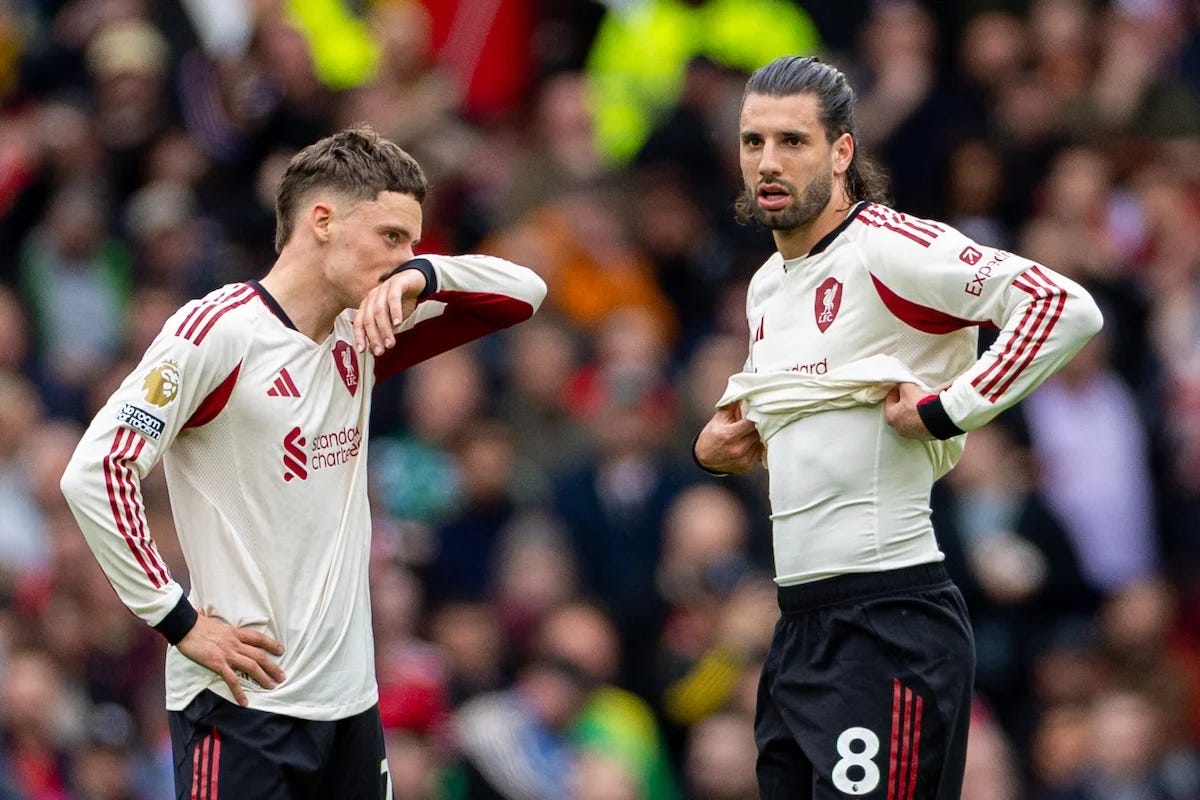
The season begging to be put out of its own misery provides yet more justification for the mercy.
I wouldn’t have been alone in expecting sweet nothing after reading the frankly ridiculous absentee list, and nor did I have total belief that they would overturn the Everest‑sized mountain they’d built for themselves in the first half, but, like the eighteen other defeats, it still hurts. ‘Blessed is he who expects nothing, for he shall never be disappointed,’ wrote Alexander Pope in the 18th century, though I’d have to disagree with the great man based on the seasonal evidence. Self‑protection isn’t necessarily wise or even effective, because numbness can cut deeper than any disappointment you’ve spent weeks building yourself up for. In many ways, that’s the real cruelty of this season: even when you brace for impact, it still finds a way to wind you. There’s only so much armour you can wear before the blows start landing anyway.
For all the very reasonable mitigation - and I am sympathetic to the second‑half effort, where Liverpool genuinely fight and land blows on the hosts - none of that really explains the inability to be up for locking horns with Manchester United. Twice now they have committed the cardinal sin of sleepwalking through halves against the club’s historical foe of all foes. Less than 200 days ago, Bryan Mbeumo slotted past Giorgi Mamardashvili to stun the Kop inside 62 seconds; by that point at Old Trafford, the Reds were already on the ropes and found themselves with a mountain to climb by the quarter-of-an-hour mark. Objective number one - stripped back to the bare bones of basics - is to know you are in a game, from the off, yet once more Liverpool are bamboozled by opposition intensity in a fixture which it is simply non-negotiable. Nobody in white, I gather, was clued up on the respective threats of the aforementioned Mbuemo, Matheus Cunha, Bruno Fernandes and Benjamin Šeško. And to that I am left asking why?
Noticeably more scathing than usual, Paul Joyce fired the nail firmly onto the head in his review for The Times: “This was an assignment demanding a backs-against-the-wall display, to dig in and grow into proceedings. Instead, Slot lamented his players “not picking up the second balls” in those early passages when the chance to set the tone was squandered. It was enough to wonder just what is said in the moments before kick-off and, more importantly, whether anyone is actually listening.” Whether Joyce is directly questioning the head coach’s authority is not totally clear, but there is no shortage of material this season to suggest that Slot has generally failed to fire a reaction out of the group in the biggest games, particularly that dismal week which saw both our FA Cup and Champions League hopes collapse.
“Well you can’t get rid of a manager for a finishing third,” has been a prominent line of discourse across a range of different multi-media platforms concerning LFC in the past week, not least from a range of different contributors on The Anfield Wrap. Well, to be blunt, he’s not finishing third for a start. It is perhaps- especially given the desperately shallow lack of forward options available - more conceivable that Liverpool totally shit the bed in their final tough trifecta and drop into a dreaded Thursday night slot than climb into the top three for the first time since early November.
Of course, in the grander scheme of things, no lasting damage, or even close, was sustained in this isolated fixture for the Champions who remain fourth in the Premier League table and need a maximum of four points from three remaining matches to secure Champions League qualification. Nothing, really, was lost. The Reds will likely finish somewhere between 15 and 25 points behind the eventual dethroners of their crown as Champions, and to some, myself included, will not bat an eye-lid at that final two-digit number; all that matters is that the silver trophy will not be paraded around the streets of Liverpool.
But the worry is that premier transfer targets do not share this viewpoint. Six English clubs - should Europa League favourites Aston Villa fulfil their destiny - could well be competing in the blue-and-black brand next season, including a [relative] minnow such as a Bournemouth or Brentford. Is, then, Champions League qualification sufficient grounds to lure the creme de la creme of European football, with a points total that at worst falls below 2014/15 and at best ties with 2022/23? Can we be sure that agents will share the blissful ignorance around the ‘off-season’ that appears to be championed by Richard Hughes and Michael Edwards, if reports are to believed? The position of strength that not only dragged Alexander Isak, Florian Wirtz and Hugo Ekitike through the door but extended the stays of both Virgil van Dijk and Mo Salah suddenly is not appearing so sturdy.
Two points from a possible 24 away from home against the top half of the league will do little to convince many that this side is almost there.
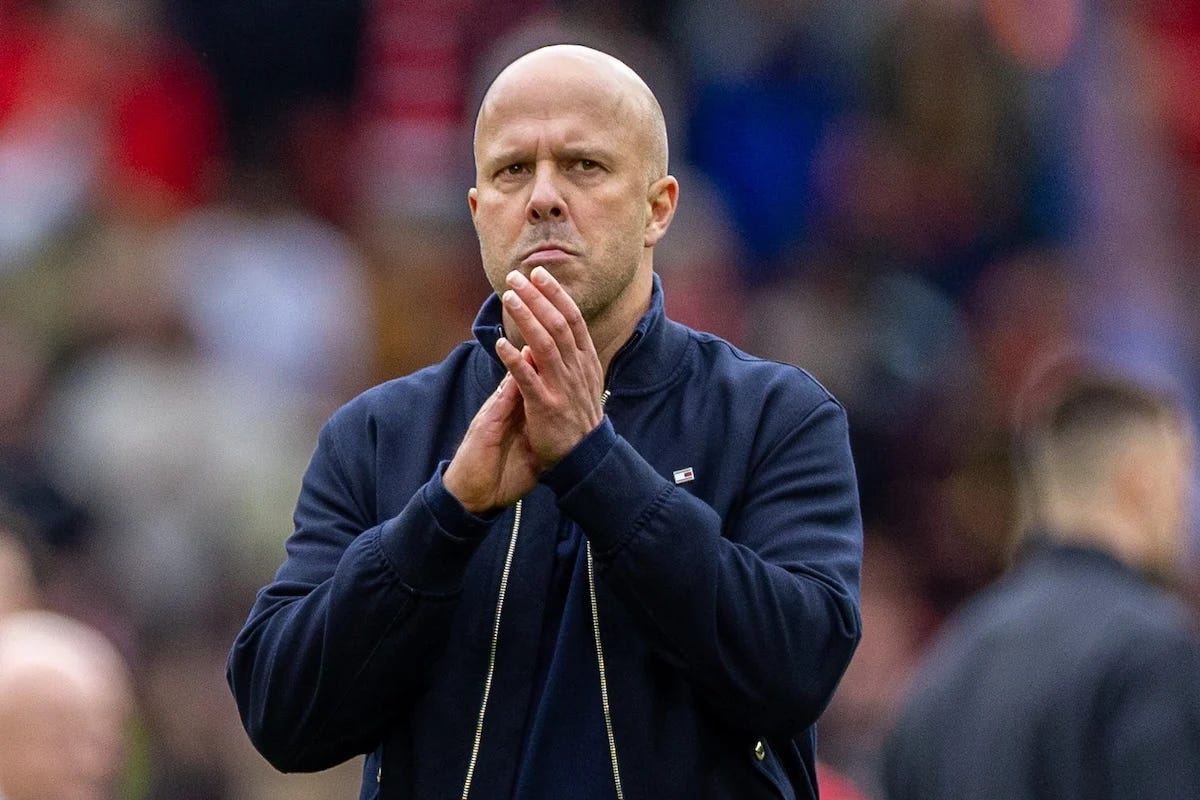
Tactically, Arne is beginning to radiate a kind of second or third season Ten Hag energy: a team that looks theoretically organised on paper, has plenty of possession patterns, but somehow still manages to leave enormous, inexplicable gaps between midfield and defence. It’s the kind of structural looseness that makes you question what the actual plan is when the ball turns over. Watching United play through those spaces brought back memories of the truly glorious 3–0 at Old Trafford in August 2024, when Casemiro and Kobbie Mainoo - the same midfield pairing as yesterday interestingly enough- were left completely exposed while Slot’s reds ran riot. The difference now is that we no longer have the physical edge or the conviction to turn those moments into goals. They can reach the right zones, but they don’t hurt you.
“The Slot machine has just paid out its first big jackpot.” I will always remember this Peter Drury commentary line from that one. Feels like a lifetime ago!
*Arne’s out-of-possession structure flattered to deceive once more. It was fairly clear though, at least: a 4‑4‑2 mid‑block, with Gakpo tucking in on the left and Wirtz and Szoboszlai forming the central pair ahead of Mac Allister and Jones. The idea seemed to be compactness between the lines and a front two that could press on triggers, but the execution was inconsistent. Often we would hold our shape for the first pass, then lose cohesion the moment United circulated the ball wide or dropped a midfielder deeper. The distances between midfield and defence stretched far too easily, and United didn’t need anything elaborate to expose it with simple rotations and third‑man movements proving to be enough to pull Liverpool apart.*
If one player embodied that first half that I have no sufficient adjectives to describe, it was Jeremie Frimpong. He lost all seven of his duels, completed none of his two attempted dribbles, and somehow walked away with a 5/10 in the Echo in a rating that feels at least three digits too kind. I can only imagine they are rated out of 100? Frimpong and Mac Allister, once more, looked particularly soft in the contest, repeatedly brushed aside in moments that demand presence and bite. Wirtz wasn’t far behind, though his softness manifests differently. As Josh Williams put it, “he shoots like his sister’s in goal,” and while that’s brutal, it captures a wider truth: too many in this squad are technically clean but physically passive. You simply cannot be a soft touch and expect to win titles. That reality has to be front and centre in the minds of all involved in our summer recruitment.
If you cost £100m or more, there has to be a phase of play you dominate compared to your global peers, ideally in possession, but out of possession works too. Right now, for all his talent and long‑term potential, Florian Wirtz isn’t doing that. £115m for a No.10 without a single goal or assist against a top‑six side is disappointing, and it underlines the broader issue in assembling a group of players who are neat, tidy, and clever, but not enough who impose themselves physically or decide matches consistently. Where are the piano carriers?
In possession, Liverpool looked like a completely different team in the second. Slot’s structure hinted at a double‑10 system, with Wirtz and Szoboszlai operating between the lines while Gakpo drifted inside from the left. Liverpool were actually very good at progressing into midfield: Jones repeatedly found Mac Allister as the free man, and those passes highlighted United’s long‑standing vulnerability in their 4‑4‑2 block. Liverpool’s buildup was clean, the rotations were smooth, and the two false nines created nice angles to receive. On paper, this should have been the foundation for sustained pressure. But once Liverpool broke that first line, the entire attack evaporated. There was no penalty‑box presence, no runner threatening depth, no one arriving with conviction. Everything ended in long shots or harmless combinations in front of United’s defence. Liverpool’s first half was essentially: tidy buildup, neat rotations, two false nines linking play… and then absolutely nothing. United quickly realised they didn’t need to overcommit, they could simply let Liverpool have the ball, absorb the harmless possession, and then counter into Liverpool’s lack of athleticism and their fragile defensive transitions.
*Jones was a reference point in buildup again & the main reason why we continued to find the spare man when United pressed high. If the plan is stick with Bradley & Frimpong in the summer then they’ll continue to be a team without clean progression from the back.
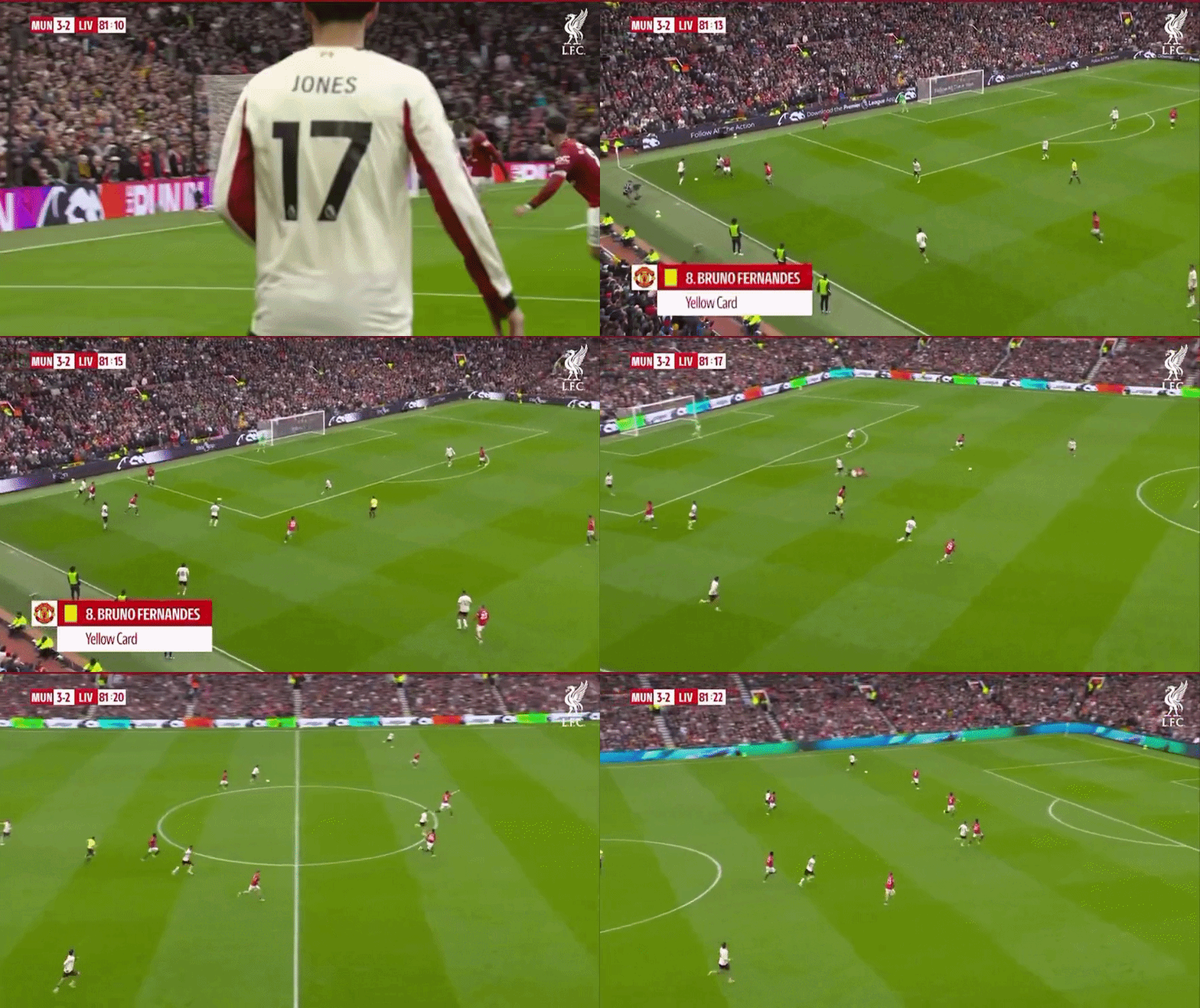
That is the core issue in the many ways: reaching the middle third is far from an issue, but they don’t frighten anyone. There’s no moment where the opposition feels under siege or forced into emergency defending. Everything is too soft, too polite, too easy to manage. United didn’t need to be exceptional, they just needed to be compact, disciplined, and ready to spring forward when our flimsy structure inevitably collapsed behind the ball.
The start of the second half was chaotic for different reasons. United, bizarrely, began with Mainoo and Casemiro making unnecessary forward runs at 2–0 up, opening lanes that didn’t need to be opened. Against a Liverpool side this light physically, that kind of looseness could easily have turned the match earlier. But, prior to that manic two-goal period, the Reds were unable to punish as they simply don’t possess the athletes or the aggression to turn vulnerable moments for the opposition into real danger. The lack of explosiveness, the lack of duel‑winners, the lack of players who can impose themselves, it all adds up. The structure, most damningly, gave no reference point to build attacks that can actually threaten a defence. Nobody pinned the centre‑backs, nobody threatened depth, and nobody made the kind of runs that force a back line to turn. Heaven and Maguire were allowed to defend facing the play for almost the entire half; LFC, not for the first time, had all of the ball, all the sterile control, all the neat little 1‑2s around the corners but with zero box presence, it never amounted to anything. It looked aesthetically fine, but nothing was happening. United quickly realised they didn’t need to overextend or take risks; they could simply sit compact, wait for Liverpool to play in front of them, and then punish the space behind with direct balls.
United’s plan was simple but effective: defend in a tight block, force us into harmless possession, and then hit space early with long passes from Casemiro or Bruno into the front three. Mbuemo, Šeško and Cunha all had clear roles in stretching our back line, and the pattern was obvious: win it, turn it, release it. Liverpool’s left side, in particular, became a target. Robertson was repeatedly isolated, and United clearly identified Jones’ side as the weak link in aerial duels, first touches under pressure, and defensive transitions. It’s no surprise Kerkez came on; the change was logical and overdue. The second goal summed up the entire dynamic of the match. Gravenberch loses it high, United transition in two passes, Bruno delivers the cross, and Šeško eventually finishes. Even if you want to debate the handball shout or question the goalkeeper’s positioning, those are secondary issues. The real problem is how instantly vulnerable Liverpool became the moment they lost the ball. There was no rest defence, no counter‑pressing structure, no ability to absorb the first pass and delay the transition. One mistake, one turnover, and the whole team was exposed.
This is the recurring theme: we can have the ball, they can circulate it, they can look tidy but without depth, without runners, without physical presence, and without a stable defensive platform behind the ball, they don’t impose themselves on matches. It is a side that can reach the middle third with ease but has no idea how to convert that into danger, and even less idea how to protect themselves when possession breaks down.
If you enjoy my work, please consider a paid subscription to receive a whole host more analytical and in-depth articles including detailed player profiles/deep dives at both first team and academy level. Alternatively, you could buy me a coffee. Thanks for reading.
Frimpong probably didnt recover from being absolutely wiped out by Heaven and getting nothing from the ref. He was gesticulating to the ref for a long time, wondering why an assault had gone unpunished.
Also, that handball that wasnt given is another inexplicable officiating decision from the Ref and Var team that Paul Tomkins has proven are either corrupt or incompetent.