

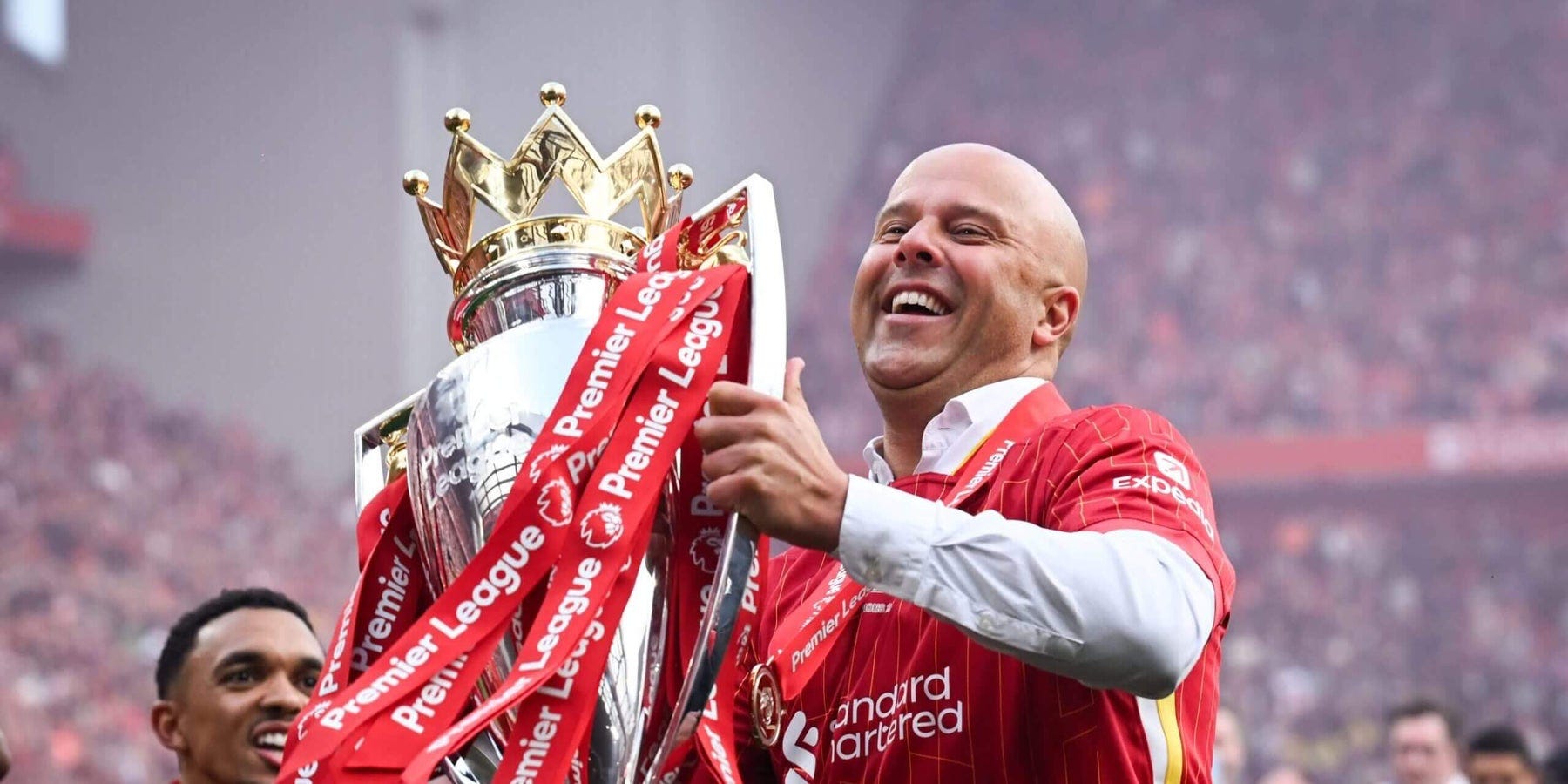
He leaves as a champion.
Since I last posted, three days ago, the head coach has been dismissed, a new one already has one foot in the door and yet another major departure on a free transfer has been announced. The latter will be covered in greater depth on another day.
If there was a way to feel both deeply surprised and unsurprised simultaneously, that was me on Saturday afternoon only hours before the Champions League final. It had looked apparent that the infamous ‘End of Season Review’ had been and gone, with Liverpool and their main covering‑journalists adamant at every turn that Slot would lead the club into next season; he was, after all, talking openly about the upcoming transfer window only a week ago. But under his watch Liverpool lost twenty times in a season, and reading between the lines of the ownership’s own words, it’s clear they - like many fans - had grown disillusioned with a style far removed from the 60‑page dossier they’d compiled on him back in the Netherlands.
Across all competitions, Arne leaves with the fourth highest win-rate in LFC history (58.4%) behind only John McKenna (69.4), Jürgen Klopp (62.1) and Kenny Dalglish (58.5) and he will forever be immortalised on the Kop in that iconic Mount Rushmore banner reserved exclusively for Premier League/First Division and Champions League/European Cup winning faces. Despite ultimately being partly culpable for the most miserable campaign in some time, I share the sentiment in the official statement in believing that the 47-year-old will enjoy further success in his career, most likely in another top five European league. It is easy to forget that prior to his arrival in the summer of 2024, replacing a transcendent figure, Slot had managed only five seasons of top-flight football, all of which coming in the continent’s seventh most competitive league. I cannot imagine that as he was rounding off his playing career with PEC Zwolle in the Eerste Divisie, some thirteen years ago, that he could even have dreamt of leading Liverpool to the most significant championship in its illustrious history.
“Liverpool’s 20th league title belongs to all of us and it will remain an important chapter in its history. For that we should all be proud. This club will always judge itself by the biggest honours. That is how it should be.” - Arne Slot
Tottenham at home, it speaks for itself. Utterly dismantling Manchester United at Old Trafford, playing rondos in their own back garden. Turning over Real Madrid twice. Watching Arsenal form a guard of honour for us. Winning the first ever Hill Dickinson battle. Thrashing Alonso’s Bayer Leverkusen. Delivering an emphatic double over then‑champions Manchester City. A title. The twentieth. And above all, guiding the club through a summer of tragedy with respect, dignity, and unwavering class during the hardest period imaginable.
*Looking back, winning 23 of your first 27, in a new country, environment and club with infinitely greater pressure and expectations in the immediate aftermath of the greatest era in decades, is obscene. Even the most legendary of them all in Bob Paisley endured a potless first year.*
He is unable, in my view, to feel hard done by the decision, given the sheer strength of unrest around him not least from, seemingly, his own playing squad. Even if you clutched at straws to the absolute nth degree in those final months, there was still absolutely nothing to hang your hat on from that identity‑less side. What he could legitimately argue, though, is that he was dealt a terrible hand by decision‑makers who now have no hiding place for their naïve and incoherent assembling of a squad.

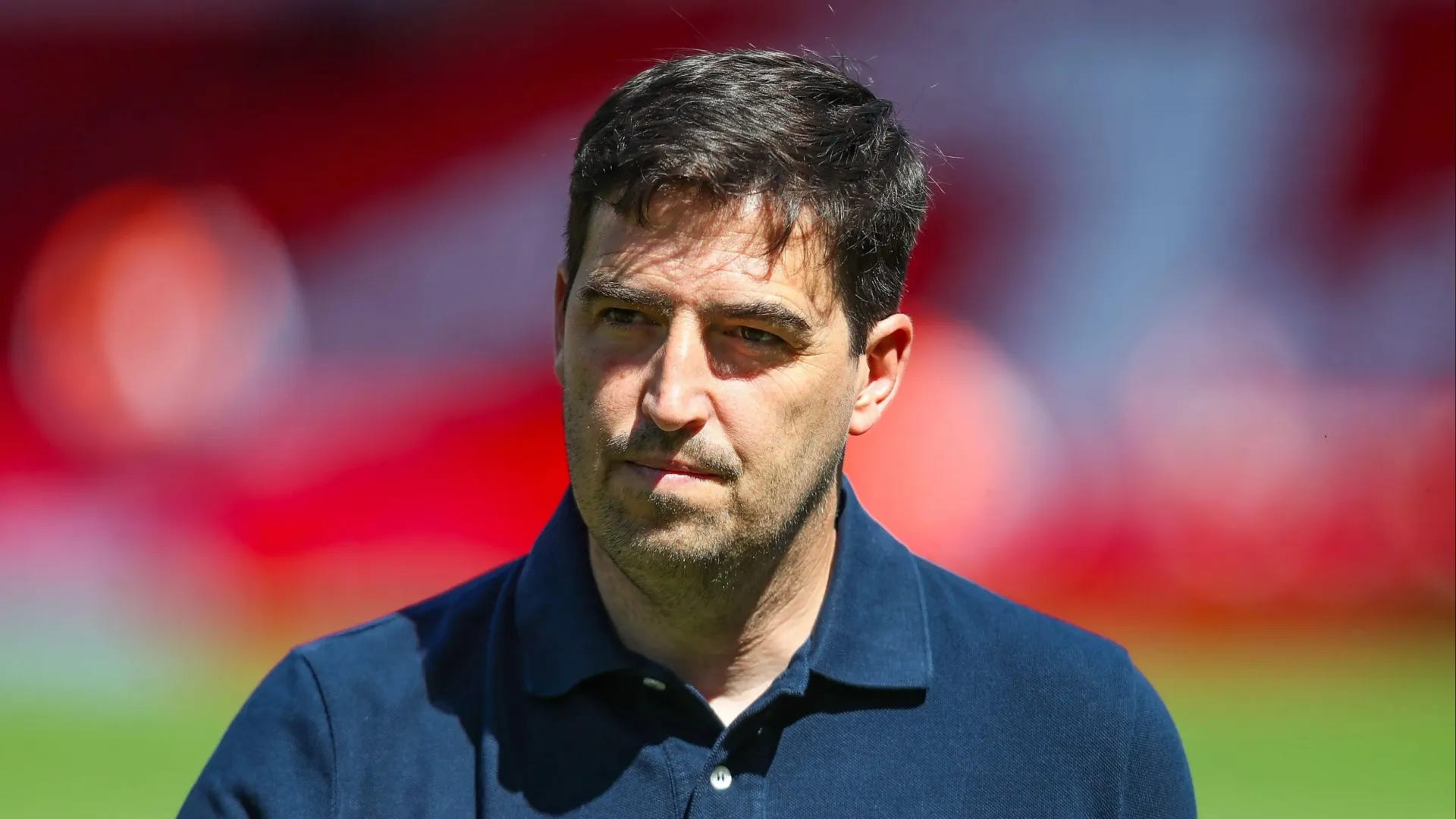
Barring an almighty late pivot, which isn’t exactly alien to Liverpool under this ownership and football structure in fairness, Andoni Iraola will be the club’s 23rd head coach, only the seventh to have previously managed in the English top flight prior to their appointment. If, only a month ago, it was revealed that a Basque country export would be in the Anfield dugout come August, I would assume that many would have placed their great bets on Xabi Alonso yet it will almost certainly now be his former teammate at Antiguoko at the helm. Interestingly, exactly half of the ‘big six’ Premier League clubs will be led by Basque managers at the beginning of next season and they were once all teammates at youth level at the same time.
His story is incredibly intriguing. It has genuinely been great fun to read about the journey, not just from an on-field perspective. I will do a longer tactical piece later this week based on his sides at Bournemouth and Rayo Vallecano, though in the meantime I cannot recommend this January 2025 interview with the Independent enough, where Iraola ‘opens up on giving players freedom, his laidback persona and how to beat the Premier League giants’. At a minimum, it is clear that he is very capable of elevating a squads physical floor; running hard, winning duels, defending the space well, pressing with intensity, with huge emphasis on verticality, high-tempo, front-footed football, manufacturing fast transitions and empowering players to play. But save that for another day.
With those who’ve worked alongside Iraola quick to describe him as methodical, obsessively prepared, calm under pressure and unusually gifted at reducing complex ideas to their simplest form, it’s little surprise to learn he once spent more than three years pursuing a law degree before finally abandoning it; the demands of starting every week in La Liga for Athletic Club made mandatory lectures and practical placements impossible to sustain. Known as a cerebral and highly intellectual football figure, he has often spoken about his love for literature, being on record for having read every work by Japanese novelist Haruki Murakami and his ultimate dream of retiring to own a local bookshop. An admitted ‘reluctant introvert’, it feels fitting that he’s drawn to an author whose stories follow ordinary people slipping into the surreal, in which loneliness, memory, time and identity blur together, with characters who are usually quiet, introspective men falling into dreamlike alternate realities. Hopefully, his time in Merseyside will be dreamy. Shelves of that future bookshop packed with stories of his Liverpool dynasty.
“If you only read the books that everyone else is reading, you can only think what everyone else is thinking.” - Haruki Murakami
Across 12 years, your typical technically clean, tactically intelligent right‑back made 510 appearances for Athletic, a number that places him sixth on their all‑time list and says more about his character than any medal ever could. You don’t play that many games for a club like Athletic - who enjoyed great times in the early 2010s, reaching the Europa League final and qualifying for the Champions League - unless you’re trusted, respected, and utterly dependable. He spent years as vice‑captain and wore the armband on countless occasions including under Marcelo Bielsa whose standards for leadership are famously uncompromising, and although he never won a trophy in that great period, he knows the ache of coming close better than most. He lived through the heartbreak of finishing second, of walking past silverware that should have been his.
*Iraola’s assistant, likely to follow him in this move, is former Aston Villa and Bournemouth defender Tommy Elphick. A Liverpool supporter growing up, Elphick previously expressed great joy as a player when Bournemouth, then of the Championship, were drawn against the Reds in the 2014/15 League Cup quarter final. Just last week, it was reported that he turned down the chance to become manager of Bristol City.*
There’s a quiet assurance about Iraola and a sense that he understands the emotional weight a giant club carries, how hope and suffering sit side by side and shape everything that comes after. He’ll need to find that delicate balance between chaos and control - the same tightrope Klopp walked so brilliantly - but it’s, to me at least, very difficult not to feel a spark of excitement at what he might build. There’s Basque fire in him, but the football is coded with a kind of German precision: structured, intense, relentlessly purposeful. It’s a fascinating mix, and you can already imagine how it might look on the pitch.
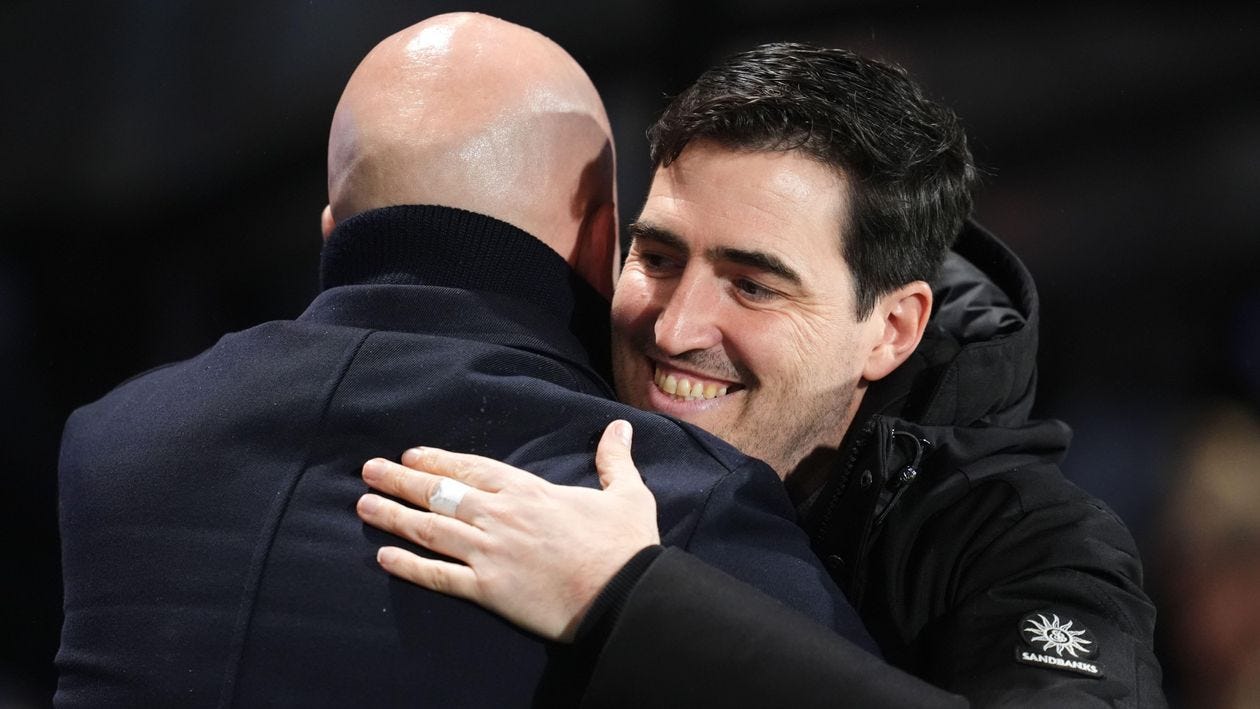
The idea of Iraola taking over has sparked a lot of debate, and understandably so. When you combine the schedule of this physical slog of a Premier League with an amplified Champions League schedule, the intensity of his style of play, and our own turbulent injury history, it raises a number of concerns that can’t just be brushed aside. After an initial period of reflection as the news broke completely out of the blue just hours before the Champions League final on Saturday, I wanted to dig deeper into the data behind those concerns, not just the surface‑level impressions, but the patterns that have followed Iraola throughout his career and whether Bournemouth’s recent trajectory tells a different story. That meant looking at injuries, first‑half vs second‑half performance, and the way Bournemouth adapted structurally and tactically across the recent season.
The first thing that stands out with Iraola is that the data absolutely matches the eye test. His football is built on intensity, and not in a vague, stylistic sense; it’s quantifiable. In 2022/23, his Rayo Vallecano side forced more high turnovers leading to shots than any team in Europe’s top five leagues except Bayern Munich. That is extraordinary for a club of Rayo’s size and speaks to how aggressively Iraola wants his teams to operate. At Bournemouth, the same identity has been obvious. Over the past two seasons, they’ve been in the 99th and 98th percentiles for high‑press shots and the 100th and 96th percentiles for aggression. These aren’t the numbers of a manager who adapts to the league; they’re the numbers of a manager who imposes his football on it. It’s thrilling, but it’s also physically demanding and supporters would be justified with any concerns as to how that level of intensity interacts with a squad that has, at times, struggled to stay fit.
That leads to the second major concern: injuries. Up until July 2025, Iraola had a very clear pattern across his managerial career. His teams started seasons strongly and faded in the second half. Crucially, this wasn’t just about results as it was about physical decline also. He had never overseen a season where the second half produced more points than the first. Every club he managed showed a negative trend after the halfway point. And this wasn’t just anecdotal. In the 2024/25 season alone, Bournemouth lost over 1100 days to injury, a staggering number for a squad with limited depth. The fear isn’t irrational: a manager whose football demands extreme physical output, combined with a club that has had its own injury issues, is a combination that deserves scrutiny.
But then the 25/26 season happened, and it complicates the narrative in a way that’s impossible to ignore. Bournemouth’s campaign is almost split into two distinct halves. They started brilliantly, sitting second after matchday nine, playing some of the most aggressive football in the league. Then came a brutal injury crisis and an 11‑game winless run between matchweeks 10 and 20. At that point, it looked like the same old story, similar to the narrative painted by doubters of Marcelo Bielsa: fast start, physical collapse, injuries piling up, results falling away. But from January onwards, everything changed. Bournemouth posted their best injury numbers in eight seasons, recorded only 153 games missed (eighth‑best in the league), went 18 games unbeaten, and - for the first time in Iraola’s career - produced a second half of the season that was significantly stronger than the first. And they did this with a budget that should place them in the lower half of the table. Not a marginal improvement. A transformation.
The obvious question is: what changed? And the answer is that a lot changed, both structurally and tactically. Bournemouth had invested over £30m in a new sports science and medical performance centre, but it only became fully operational in January 2026. The opening of the performance centre marked a shift in how Bournemouth functioned behind the scenes. It created a more connected environment, where medical, conditioning, data and coaching staff were aligned in their planning and decision‑making.
For a manager whose football demands precision and physical resilience, this kind of infrastructure matters enormously. Alongside that came the arrival of Dr Robert Marshall from RB Leipzig in summer 2025 who became Director of Medical and Performance and was tasked with ensuring that every department - medical, conditioning, data, nutrition, recovery - worked in harmony with Iraola’s demands. Iraola has spoken extremely highly of him, and it’s clear that Marshall played a central role in stabilising the squad. Another factor was the age profile of the team. Bournemouth had the second‑youngest squad in the league, which naturally helps when playing high‑intensity football. Younger players recover faster, tolerate load better, and adapt more quickly to tactical demands, but perhaps the most important change was Iraola himself. He adapted. He made tweaks based on performance‑centre recommendations - changes to training intensity, session structure, in‑game setup, rotation patterns, and the timing of substitutions. These weren’t cosmetic adjustments; they were strategic shifts designed to preserve energy and reduce injury risk which very much worked. If the performance centre had been fully operational from July 2025, Bournemouth’s injury numbers for the season might have looked even better, because the first‑half data still drags the average down.
All of this matters when thinking about the stylistic fit here. There is still plenty to analyse - his tactics, his in‑ and out‑of‑possession structure, his leadership, his authority, his training methodology - but the work done at Bournemouth from January 2026 onwards suggests that Iraola can collaborate effectively with a high‑level performance staff. At Liverpool, he would have even greater resources across sports science, data, conditioning, and medical departments. Importantly, he has now broken the trend of his teams collapsing physically and results‑wise in the second half of a season. That doesn’t erase the concerns, but it does provide evidence that the issues weren’t inherent to Iraola’s football: they were, at least in part, structural. There is still, clearly, a lot he needs to prove. Managing a Premier League season and a European campaign simultaneously is a major test, and our expectations are far higher than Bournemouth’s, however Iraola can legitimately point to the lack of a performance centre at Bournemouth until recently, and the dramatic improvement once it was integrated, as evidence that he can balance intensity with sustainability when supported by elite infrastructure.
The key will be how quickly he adapts to the new staff and systems. This is where Thomas Frank reportedly failed at Spurs. The flip side is that, with Liverpool’s expanded sports science and data departments, Iraola’s model could be enhanced even further - potentially transforming the physical and tactical profile of the team in a way that aligns with the hierarchy’s long‑term direction for the club.
*On his recent appearance on the All Out Football podcast, Antoine Semenyo spoke openly about Iraola’s relentless demands. “The way he structured the weeks, we didn’t really have any days off, nothing.” He explained that under previous managers they would get Wednesday and Sunday off, but Iraola removed that completely, describing playing on Saturday, then training again on Sunday, with starters doing 30–40 minutes of intense work despite being exhausted. Even after moving to Manchester City, he said Bournemouth players were still messaging in the group chat: “No day off this week again.”*
I would like to end by dismissing the nonsensical obsession of some with the 38% win rate at Bournemouth. Again, at Bournemouth. The back-to-back Champions League winning Luis Enrique, prior to joining Barcelona in 2014, had posted a 37% win rate at Celta Vigo in La Liga. The rest is very much history.
The Cherries lost four of their five starting backline in the summer and then lost their best forward in January, yet somehow they still found themselves just three points off the Champions League places in the kind of overachievement that shouldn’t make sense on paper, but did because of the way they were coached and the way the squad adapted. After being told all season how unforgiving the league is, it’s bizarre to see people sneer at Bournemouth putting together an 18‑match unbeaten run. That consistency in this division is rare. Focus on a two-month winless streak is absolutely fair - would certainly be fuel for interrogation at a bigger club - though the reality is that the sixth place side, in any division, is likely to endure at least one baron run in a season. They were, based on expected points, the Premier League’s third best performing side in 2024/25 and the fifth in 2025/26.
Worthy of Champions League qualification in consecutive seasons. Again, at AFC Bournemouth.
If you enjoy my work, please consider a paid subscription to receive a whole host more analytical and in-depth articles including detailed player profiles/deep dives at both first team and academy level. Alternatively, you could buy me a coffee. Thanks for reading.
Slot also had a track record for goals from high turnovers.
His Feyenoord team were league leaders in that metric and Liverpool continued to do it more than others even in this season that got him sacked.
I sincerely hope Iraola succeeds. I really do. But i doubt it.
Because success, for the majority of the delusional Liverpool fanbase, means that he competes/wins the League and plays/wins one or more cup Finals, Champion League included. Additionally, playing attractive attacking football.
Anything less is a failure.
Of course, no excuses allowed...(deaths, injuries, fall of performance of key players, criminal decisions against from refs/var, alien invasion...ecc).
The injury crisis mentioned, is very worrying. Similar crisis plagued some of Klopp's teams, and Klopp had much greater experience in competing in multiple fronts. I can't see how Iraola, in his 1st season at Liverpool will manage to avoid such injury crisis.
Slot had already, before Liverpool, experience in competing in multiple (domestic and international) fronts, and in his 1st season managed superbly to avoid such crisis, keeping the team fresh until the end (although he didn't rotate very much due to his lack of confidence to Liverpool's reserves).
In his 2nd (and last) season, the catastrophic, season ending, type of injuries that happened (broken legs and ligaments), unfortunately were not preventable by no means.
These, along the loss of form of many key players (lack of preseason + Zota's death), the "too many" new players (loss of cohesion) most of them without PL experience (wrong transfer strategy?) , and the too many wrong decisions against from refs/var. ( penalties/red cards/DOGSO) cost him his job.
I wish i am wrong