

An experiment to see how it plays out when two poor, underperforming football teams meet with very little jeopardy on the line.
Doctor Liverpool will see you now. Expect a remedy. Yet another crisis-ridden football club - see previously Igor Tudor’s Tottenham Hotspur and Ruben Amorim’s Manchester United1 - rocks up at Anfield and jabs themselves in the arm with a confidence‑boosting injection. Chelsea, led by a novice even lacking a UEFA Pro License, losing their previous six league fixtures by an aggregate score of 14-1, are inexplicably able to flick a switch and look comfortable at Anfield.
Champions of the Premier League versus Champions of the World, that was. Allow that time to properly sink in. Both sides take a point but, to be frank, neither are close to worthy of taking home anything other than grand shame, perhaps more so the visitors considering that they were armed with all of their big hitters. I have sat through some serious amount of slogs over the years since my first match in 2009/10, produced by Liverpool sides that were far away from any conversations for the Champions League places, yet I genuinely cannot recall many - especially ones where, ultimately, we didn’t lose - that felt this draining to sit through. It was like watching a team - a pair of teams - trying to play football underwater with a tempo resembling a pre-season friendly. Fractious and sanity-testing to the nth degree. At least, however, the club have reversed their ticket-price hike which meant that half-time Carlsberg could numb the pain.
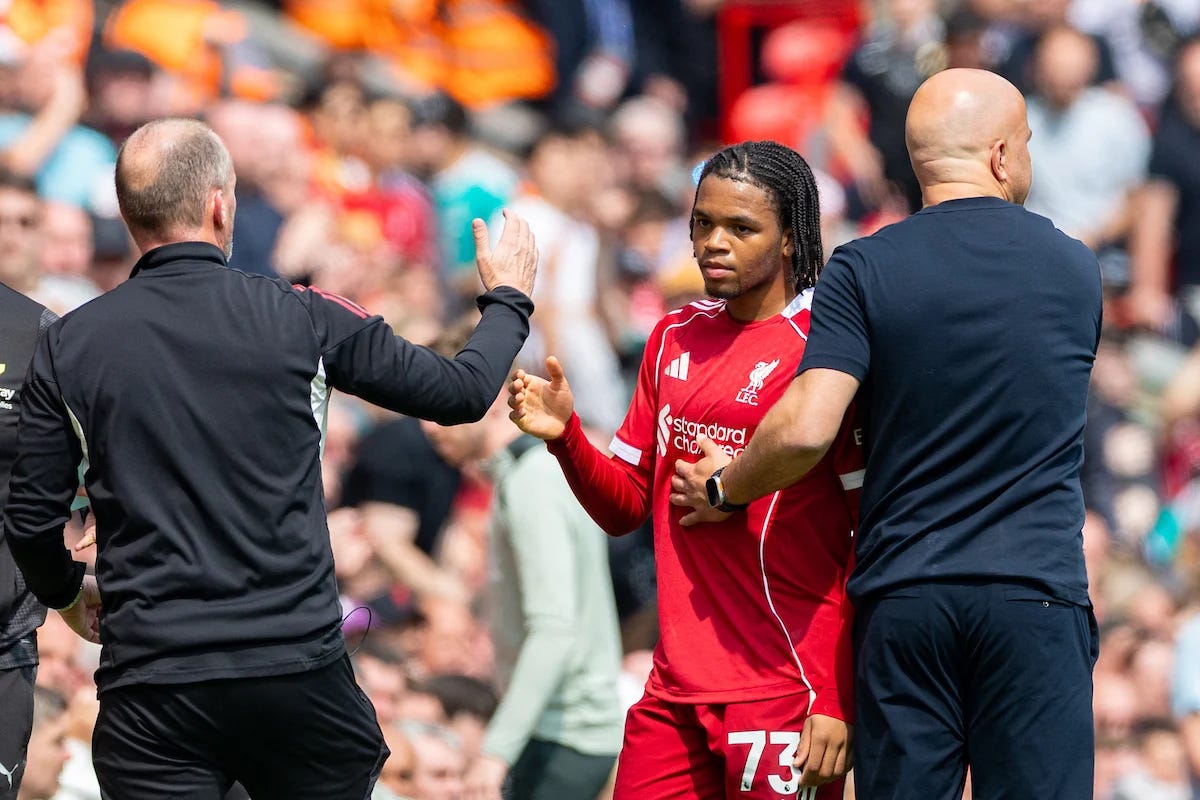
Any goodwill, generally speaking, from the title win appears to have evaporated. Frustrations had of course spilled over after the hammering at the hands of PSV Eindhoven and drab draws with Burnley and Tottenham Hotspur, yet this truly was the day that an apoplectic Anfield lost its patience with the sterile passivity that serves as the antithesis to everything it has ever known. Actively jeering the lack of pressing and lack of action on the ball, the knowledgeable crowd could sense the equaliser coming a mile off. While I did not contribute to the almost violent levels of anger at the withdrawal of Ngumoha at the mid-point of the second half - very clearly a player health longevity directive and it’s annoying but long term it’s absolutely the right thing to do - there was a real feeling of ‘for your sake, hopefully that does not read no.73 on the board’ as Alexander Isak stood on the touchline. And besides, Cody Gakpo recorded his first touch three minutes before half time (not exclusively his fault). Jeremie Frimpong delivered yet another bemusing display.
“Can’t we have anything fun?”
The physical base simply hasn’t been built and it is brutally apparent in every movement, every duel, every moment where a side with real conditioning would push through the fatigue and instead our players are visibly running on whatever fumes are left, because they simply don’t have the fuel for ninety minutes at this level after a ten month period that has drained them to the bone. Injuries, it must be stressed, are only stoking the fire as the inevitable domino effect leads to the overplaying of individuals - see the statistics: Alexis Mac Allister, one duel won out of nine, Dominik Szoboszlai one out of seven, Ryan Gravenberch five from eleven. It cannot only be the head coach whose performance is interrogated at the end of the campaign! Chelsea, for what it’s worth, had a disrupted pre‑season of their own because of the Club World Cup, and yet they’ve been so blunt and ineffective for over a month that their inability to do literally anything of note in the second half only reinforces the point: they’re exhausted, we’re exhausted, and when two teams with no legs and no rhythm meet, the inevitable outcome is the steaming pile of turd we all had to sit through.
“It takes two teams to make a shit match.” - Damian Kavanagh, The Anfield Wrap.
*Chelsea, on average, cover the fewest KM per game in the Premier League. They had previously been outran in each and every one of their league fixtures. Until they enter the Anfield pitch…*
And beyond the fitness issues, there are the more uncomfortable truths about quality. With respect, when you look down one flank and see Jeremie Frimpong as the most advanced player in red, and down the other Marc Cucurella doing the same in blue, it’s impossible not to yearn for the not-so-distant past when those respective positions were occupied by Mohamed Salah and Eden Hazard in their absolute pomp. The odd glimpses of class are on show - pretty much exclusively from Ryan Gravenberch, Moises Caicedo and Enzo Fernández - yet not even consistent enough across the ‘90 let alone a full season which epitomises why both clubs head to their summer holidays potless.
When you’ve got senior players squabbling on the pitch about who’s meant to be picking up who, or who’s supposed to press and when, it’s a pretty clear sign that something deeper is wrong. Anger is fine - it’s immediate, it’s emotional, it’s woven into the fabric of this club and its supporters - but there comes a point where it has to shift from pure frustration to actually finding a way to turn things around. Right now, the Reds are entirely mindless off-the-ball and that likely stems from the uninspiring, unclear instructions.
Some will laud the ‘passion’ and ‘heart’ of, for example, Dominik Szoboszlai taking matters into his own hands to force pressure on the goalkeeper. But nobody else is on the same page. The Hungarian - on numerous occasions at that - vacates his position, Chelsea’s technically-secure defenders2 inevitably are not fazed by a 3v1 situation and he is taken out of the game. Likewise, Alexis Mac Allister deciding to fly into a series of challenges for a five-minute spell after half-time only left you wondering why the Argentine is a complete non-entity for the other 85 minutes. By minute ‘50, he’s reverted to type and is second to 75/25 duels in his favour. It also would not be a Federico Chiesa substitute cameo without a lack of discipline and the concession of fouls.
Point is: mindless, rogue, shite akin to this does not cut it in successful football teams. But we must consider why, consistently, they are so eager to go off script.
It’s somehow both extremely passive and confusing at the same time, with Chelsea repeatedly creating 4v3s and 3v2s across the pitch, a structural issue that inevitably breeds frustration in red and leads to those “fine, I’ll do it myself” moments from Szoboszlai as he tries to force some intensity into a system that isn’t giving him any. The irony, of course, is that he’s also the one most often gesturing for teammates to slow things down in potential transition moments which only adds to the contradiction. Gakpo, through the middle, looked completely unclear on his role, and Gravenberch spent one phase pressing high, the next trying to block Caicedo’s progression, then suddenly realising no one had stepped onto Enzo so he had to shuffle across - which in turn left Caicedo free again. What you’re seeing is not individual failure but a breakdown of collective structure: players constantly switching tasks, no clear reference points, and no shared understanding of who handles what. It is, simply put, a mess. Every correction creates a new problem somewhere else.
Still, winning the odd tackle would go a long way…
Chelsea threatened us in the same way three times in the half, and the repetition is the most damning part. Their midfielders kept dropping into the backline to create a temporary three‑man build shape, yet our response was almost non‑existent. With a high line and no pressure on the ball, Chelsea were able to hit the same long diagonal into the space between centre‑back and right‑back over and over again. It wasn’t clever or disguised and nor did it need to be, it was simply exploiting a team that cannot pass runners on or track movement with any collective understanding.
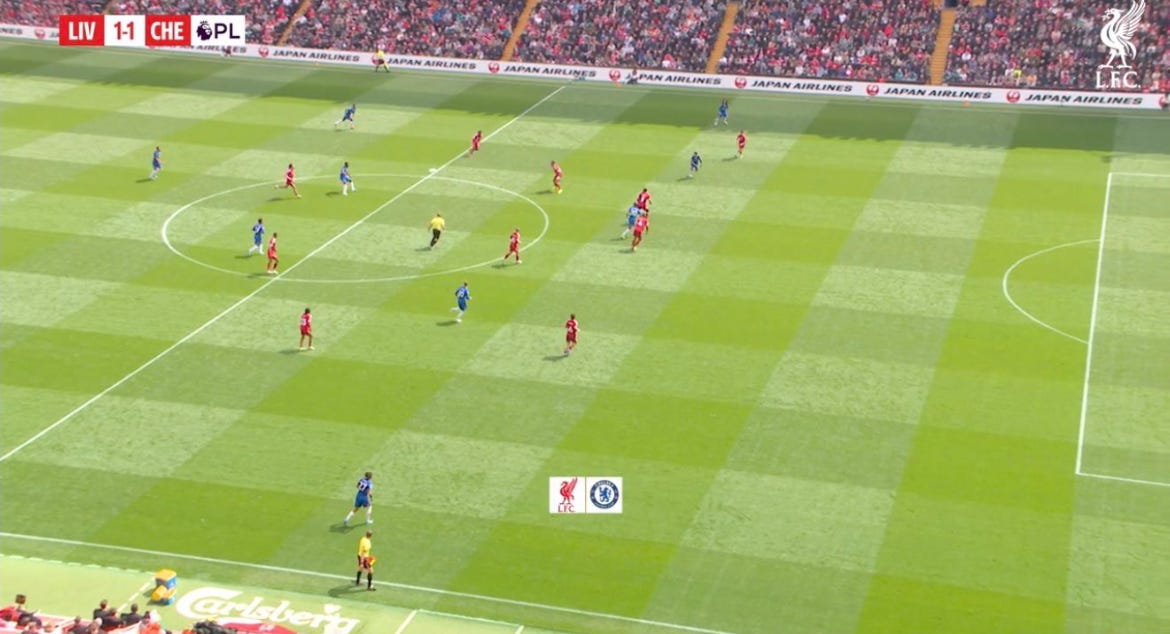
The instinct is always to blame individuals or to think a positional tweak will solve it, but the issue is far more fundamental. Changing who stands where does nothing when the underlying principles are broken. Slot’s side applied no pressure on the ball, the central structure remained passive, and Palmer in the 10 kept finding pockets because no one seemed clear on who should step in, who should hold, or who should cover. Even when Liverpool created a numerical advantage at the back, that spare defender didn’t step in or across, which meant the overload existed only on paper, not in behaviour. The front line didn’t help either. There was no coordinated pressure from the front, and on the rare occasions someone did jump, the second line didn’t follow. That disconnect is fatal: the first line presses, the second line stays passive, and the opponent simply plays through the gap. It’s the same pattern we’ve seen for months: a team that presses in fragments rather than as a unit, leaving huge distances between lines and no shared triggers.
This is, in short, why we are currently one of the easiest sides to play through in the league. The out‑of‑possession principles are incoherent: distances are too big, roles are unclear, and the collective timing is completely off. Opponents don’t need to be inventive - simply just somewhat organised. Chelsea didn’t break LFC down with quality, they simply repeated the same pattern because nothing in Arne’s structure discouraged them from doing so. At some point, the question shifts from whether the players are executing the plan to whether the plan itself is fit for purpose. These issues have persisted across different personnel, shapes, and game states. They are systemic, not incidental. And that leads to the unavoidable conclusion: when will the penny drop, across literally any area of the club, that the problem is as much about instruction as the squad quality.
If you enjoy my work, please consider a paid subscription to receive a whole host more analytical and in-depth articles including detailed player profiles/deep dives at both first team and academy level. Alternatively, you could buy me a coffee. Thanks for reading.
Even Sean Dyche’s Nottingham Forest, to a lesser extent. 19th at the time. Arrive at Anfield. Win 3-0.
Levi Colwill, I thought, was particularly impressive. It is clear why the club fancied the young defender for so long.
Great article Leo. Totally agree regarding the lack of physicality in the team, what has happened to their conditioning? I would add that there doesn't appear to be anybody in the coaching set up to challenge Slot on his first team selection, training, conditioning etc. Jurgen Klopp had Pep Ljinders as a sounding board and to challenge him on all first team matters. Slot does now look lost and if he continues into next season I can see the axe falling in October, which would leave Liverpool between a rock and a hard place.
We are an utterly uncoached side. Imagine having no plan for Palmer, who strode around the midfield untouched, untroubled. He looked like he had a 10-metre invisible bubble around him.